
· OWON Technology · Smart Energy Meters · 21 min read
PC471 Selection Guide: Which UniClip or TrioClip Meter Fits Your Site
Which PC471 fits your site: UniClip or TrioClip, single-phase or three-phase, Tuya App or Open API. Four questions settle the model number.
One hardware platform, eight models, two integration paths — here is how to pick the right one without over-specifying.
Choosing a DIN-rail energy meter usually goes wrong in one of two directions: buying a single-phase unit for a property that has three-phase service, or paying for an integration path that the project will never use. The OWON PC471 is a 19 mm DIN-rail energy meter family that measures through open-type split-core CT clamps — one housing, one accuracy class, one metering feature set — and it is wide at the same time: single-phase and three-phase, up to 750 A, from an app-based setup to a fully headless Open API. Eight models are compared here; the CT clamps are chosen separately, by bore and rating.
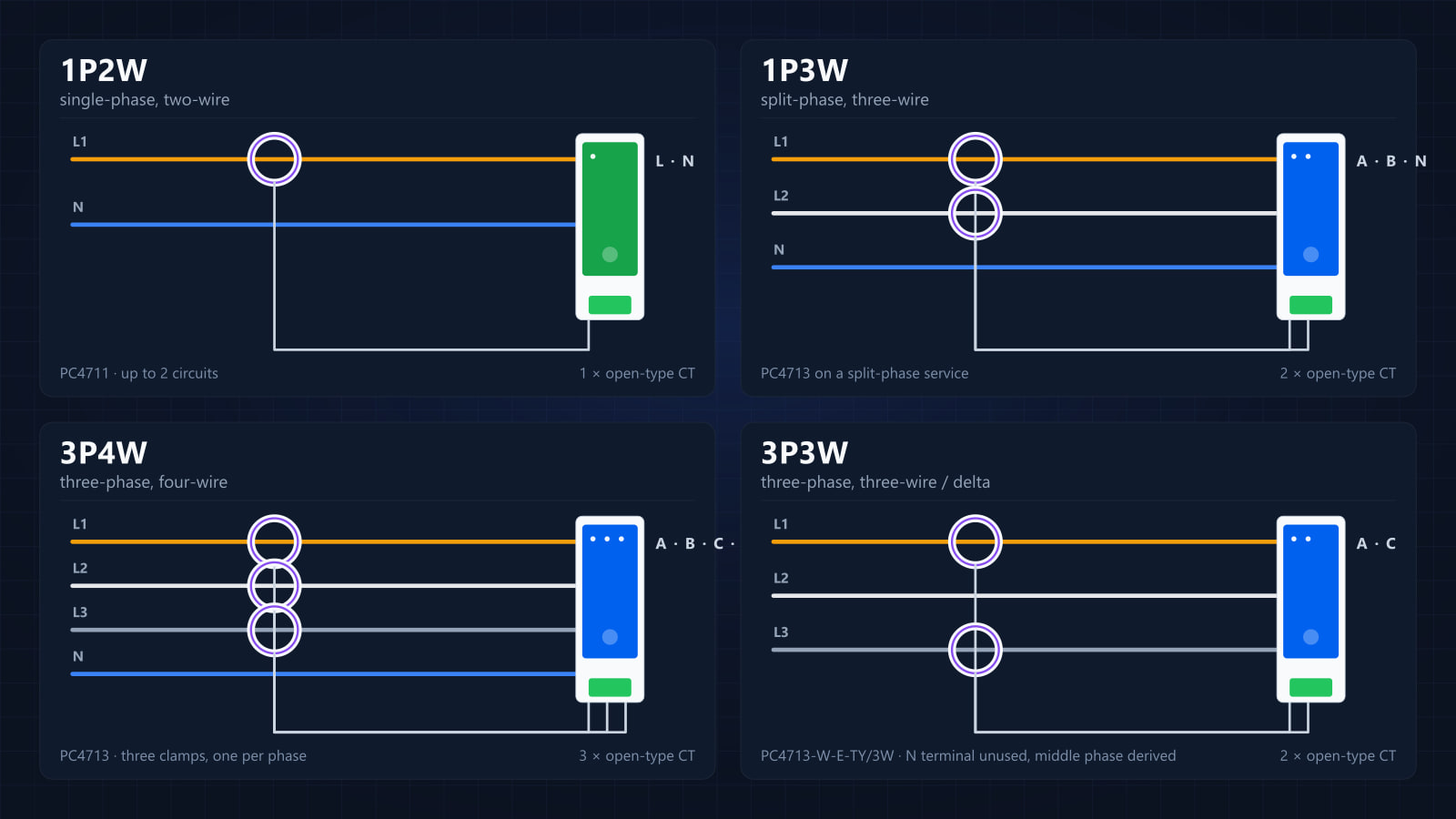
One decision sits outside the feature tables entirely, so it is worth stating before anything else: a three-phase three-wire (3P3W) site has no neutral, and that makes it a hardware choice rather than a configuration choice. Only one standard model covers it.

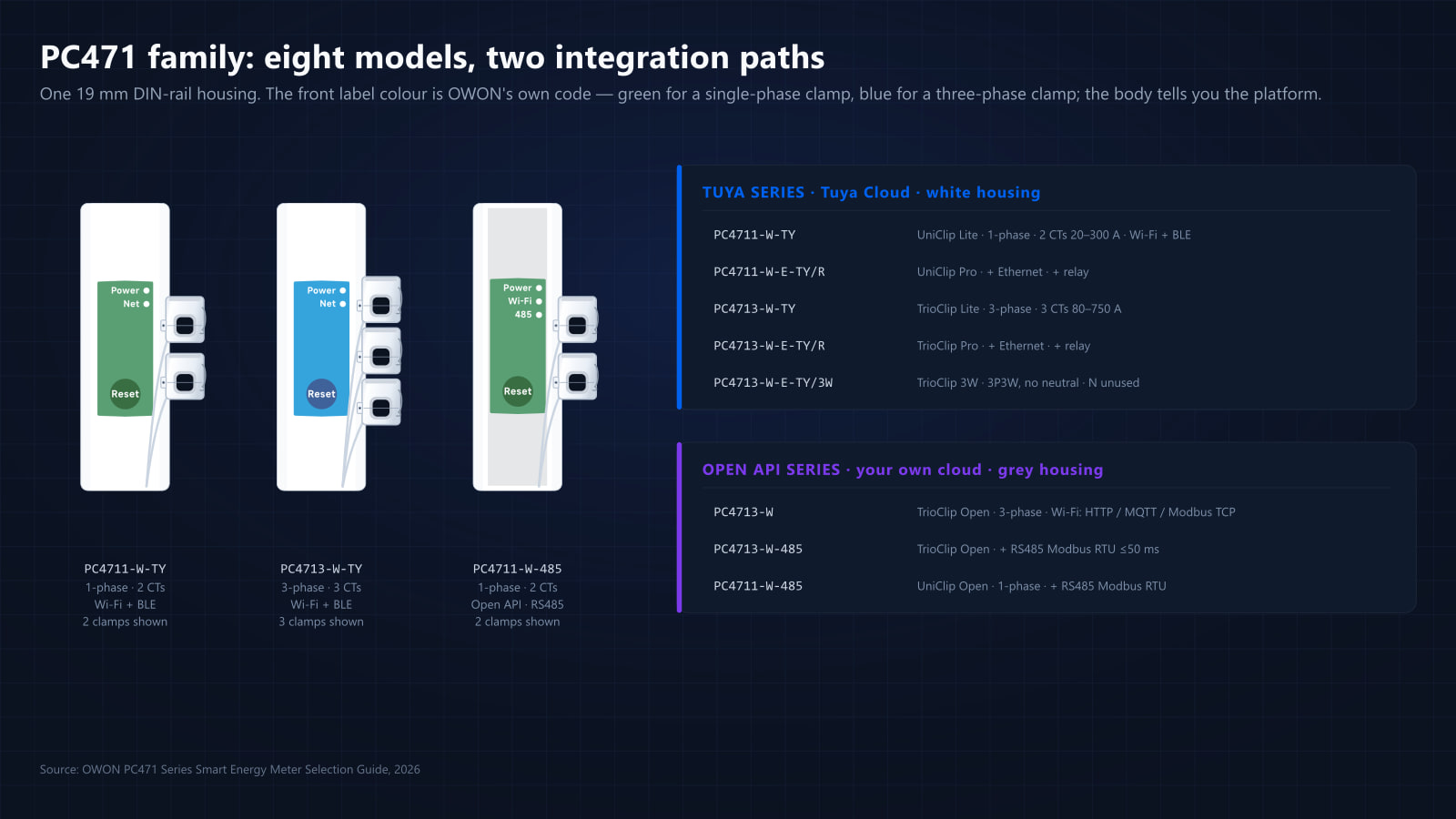
The models compared here: five Tuya models and three Open API models. The classification drawings carry OWON’s own colour code — a blue tab for a three-phase clamp, a green tab for a single-phase clamp, a white body for the Tuya platform and a grey body for the Open API platform.
The decisions that sit around the model number have their own companion guides: CT sizing for bores, ratings and non-standard orders, the Tuya Cloud versus Open API choice for where the data lands, and wiring and commissioning for the site work.
Quick answer: four steps to a model number
If you only read one thing, read this. The four questions below eliminate models in order — system type, CT fit, data destination, then whether you need to switch a load.
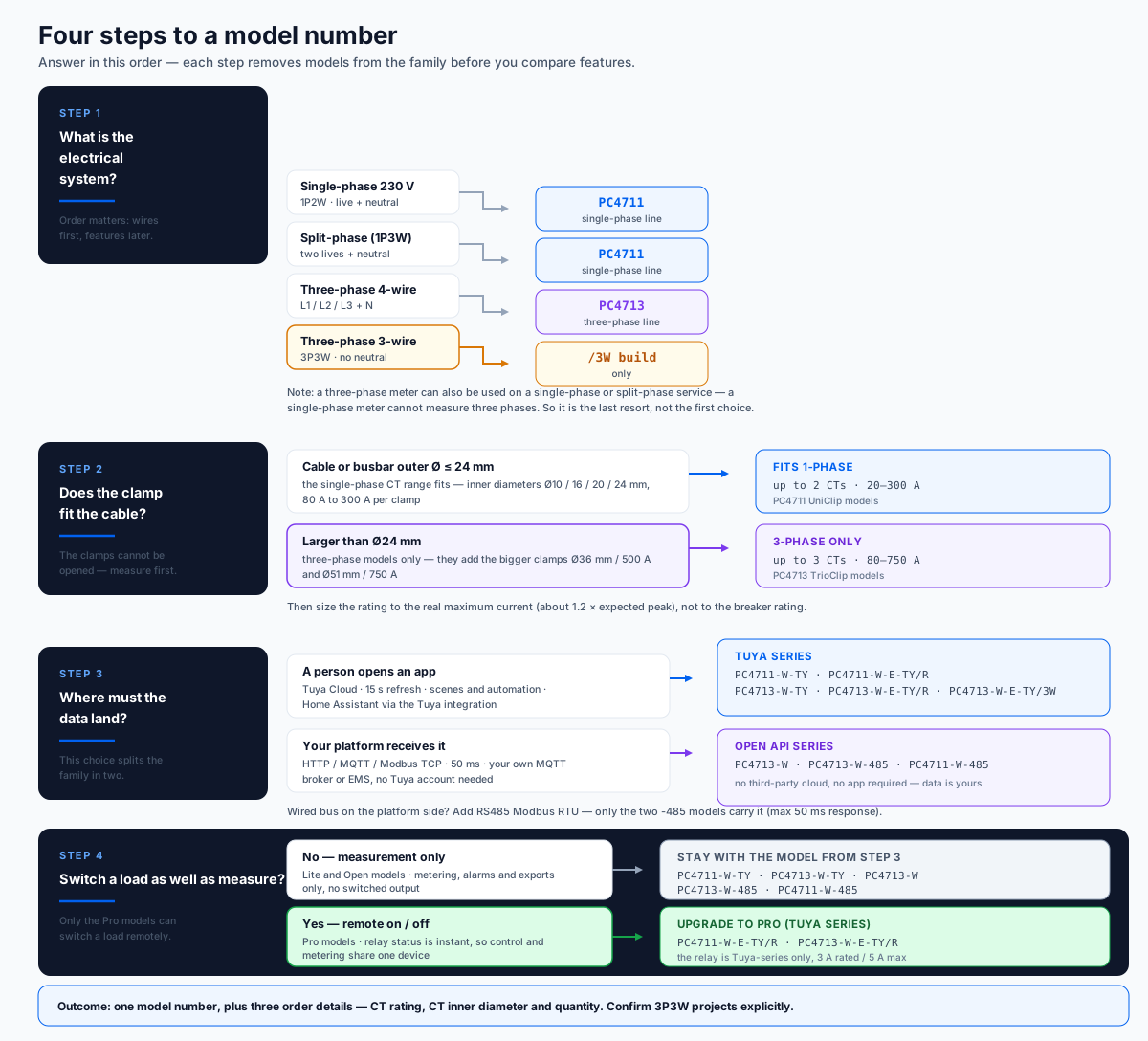
Four steps, in this order. Step 3 is the fork that matters most: it decides between the Tuya Cloud and your own cloud.
| Step | Question | What it decides | Where to read more |
|---|---|---|---|
| 1 | Single-phase, split-phase, three-phase 4-wire, or 3P3W? | PC4711 line vs PC4713 line; 3P3W needs /3W hardware | System type |
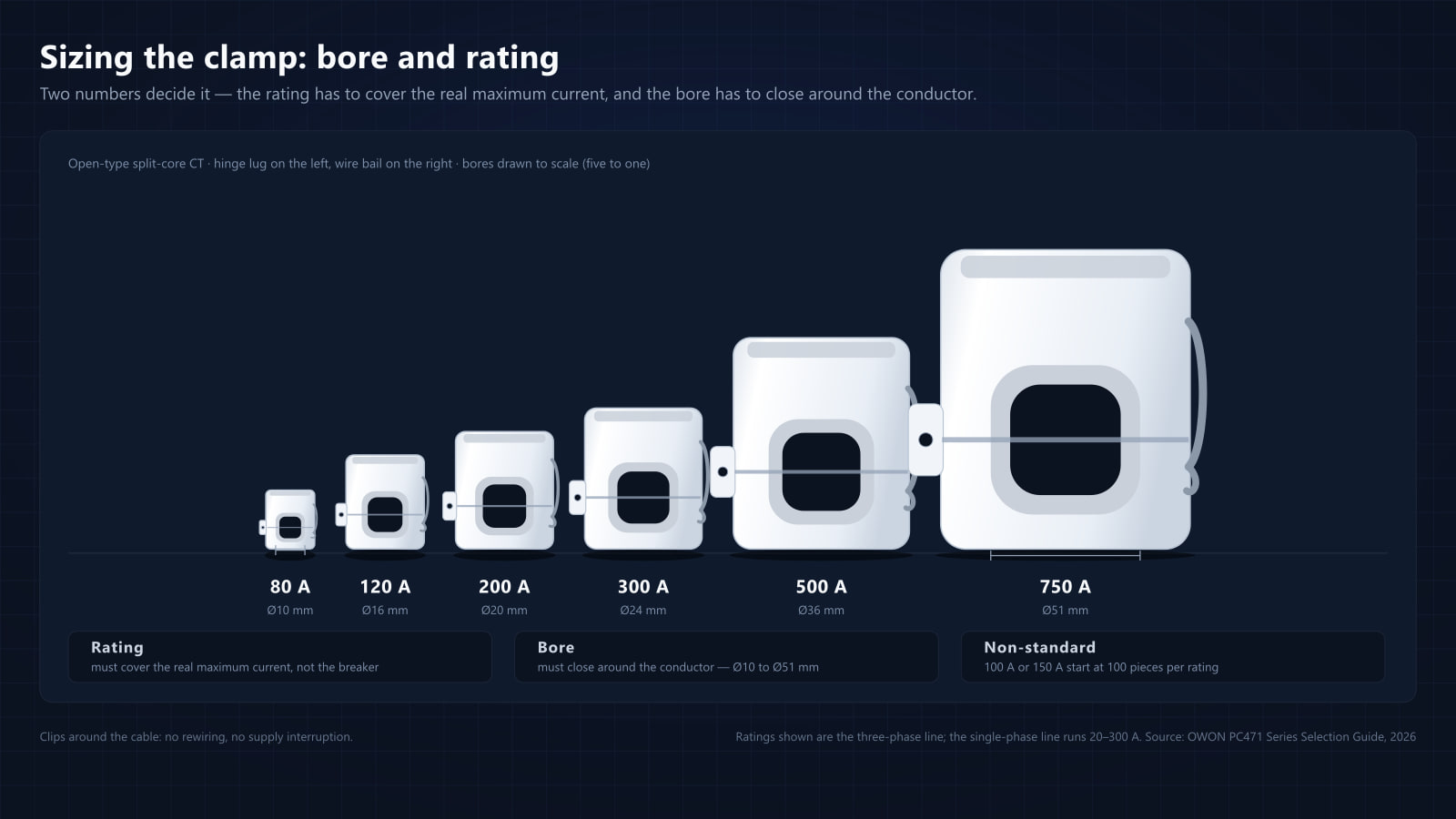
| 2 | Does the CT clamp physically fit the cable? | Single-phase CT range (≤Ø24 mm) vs three-phase range (to Ø51 mm) | CT sizing |
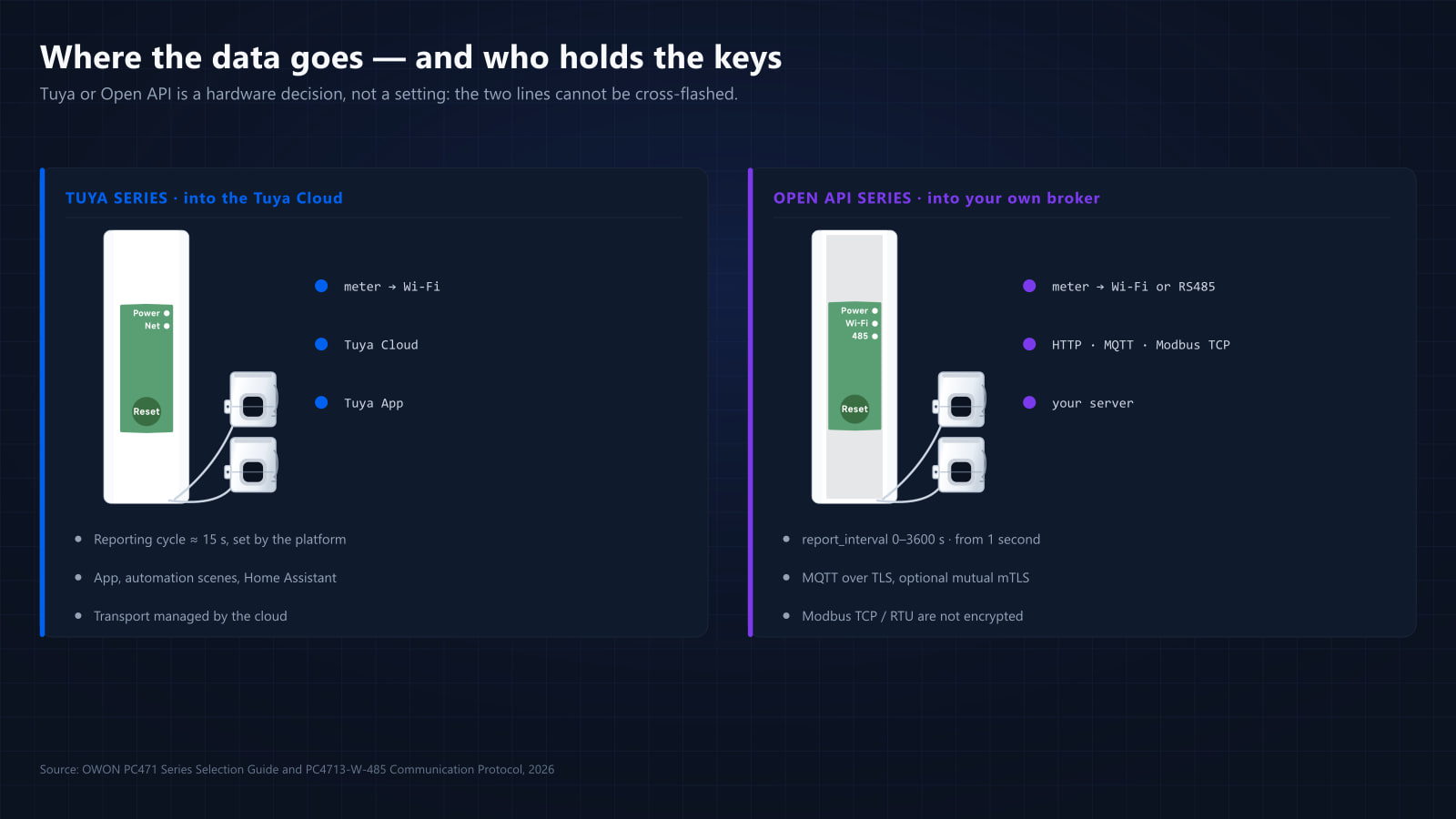
| 3 | Does the data go to the Tuya App or to your own platform? | Tuya series vs Open API series | Data destination |
| 4 | Do you need to switch a load remotely? | Lite / Open vs Pro (dry-contact relay) | Tuya series table |
Model comparison at a glance
A compact side-by-side of the eight models this guide covers — the 3P3W build is one of them. The row-grouped matrix below adds every remaining specification.
| Model | Name | Series | System | CTs | CT Ø | Connectivity | Data to |
|---|---|---|---|---|---|---|---|
PC4711-W-TY | UniClip Lite | Tuya | Single-phase | 2 · 20–300 A | Ø10–24 mm | Wi-Fi + BLE | Tuya Cloud |
PC4711-W-E-TY/R | UniClip Pro | Tuya | Single-phase | 2 · 20–300 A | Ø10–24 mm | Wi-Fi + Ethernet + BLE | Tuya Cloud |
PC4713-W-TY | TrioClip Lite | Tuya | 1P / Split / 3P 4W | 3 · 80–750 A | Ø10–51 mm | Wi-Fi + BLE | Tuya Cloud |
PC4713-W-E-TY/R | TrioClip Pro | Tuya | 1P / Split / 3P 4W | 3 · 80–750 A | Ø10–51 mm | Wi-Fi + Ethernet + BLE | Tuya Cloud |
PC4713-W-E-TY/3W | TrioClip 3W | Tuya | + 3P 3W | 3 · 80–750 A | Ø10–51 mm | Wi-Fi + Ethernet + BLE | Tuya Cloud |
PC4713-W | TrioClip Open | Open API | 1P / Split / 3P 4W | 3 · 80–750 A | Ø10–51 mm | Wi-Fi | Your cloud |
PC4713-W-485 | TrioClip Open | Open API | 1P / Split / 3P 4W | 3 · 80–750 A | Ø10–51 mm | Wi-Fi + RS485 | Your cloud |
PC4711-W-485 | UniClip Open | Open API | Single-phase | 2 · 20–300 A | Ø10–24 mm | Wi-Fi + RS485 | Your cloud |
Relay and phase-sequence alarm are the two features that separate otherwise identical models. Among the models covered here, the relay (3 A rated / 5 A max) is fitted only to the two whose part number ends in /R — PC4711-W-E-TY/R and PC4713-W-E-TY/R — and the phase-sequence alarm appears on every three-phase model, the 3P3W build included — it is the relay that the 3P3W build does without.
One availability note before the tables: the two single-phase Open API models — PC4711-W and PC4711-W-485 — are the newest additions to the line and are coming soon, while the three-phase Open API models ship today. The integration guide covers what that means for a project plan.
Also in the family, outside these tables. The platform runs on past the eight models compared here: further single-phase variants include PC4711-W-TY/R (relay output, no Ethernet), PC4711-W-TY/3CT (three independent single-phase circuits in one 19 mm unit — three single-phase loads, not a three-phase service) and PC4711-W (Open API over Wi-Fi only, no RS485 port). They follow the same single-phase electrical envelope: 90–277 V, bidirectional metering, 20–300 A CTs. Ask your sales contact for the current part-number list when a project needs a combination that is not in the tables above.
Full specification matrix: all eight models
This is the complete comparison of the models covered here — the published specifications that decide a selection. It is wide by design; scroll it sideways on a phone.
Series and identity
| PC4711-W-TY | PC4711-W-E-TY/R | PC4713-W-TY | PC4713-W-E-TY/R | PC4713-W-E-TY/3W | PC4713-W | PC4713-W-485 | PC4711-W-485 | |
|---|---|---|---|---|---|---|---|---|
| Series | Tuya | Tuya | Tuya | Tuya | Tuya | Open API | Open API | Open API |
| Name | UniClip Lite | UniClip Pro | TrioClip Lite | TrioClip Pro | TrioClip 3W | TrioClip Open | TrioClip Open | UniClip Open |
| Form factor | Single-phase | Single-phase | Three-phase | Three-phase | Three-phase | Three-phase | Three-phase | Single-phase |
System and power
| PC4711-W-TY | PC4711-W-E-TY/R | PC4713-W-TY | PC4713-W-E-TY/R | PC4713-W-E-TY/3W | PC4713-W | PC4713-W-485 | PC4711-W-485 | |
|---|---|---|---|---|---|---|---|---|
| Supported systems | Single-phase | Single-phase | 1P / Split / 3P 4W | 1P / Split / 3P 4W | 1P / Split / 3P 4W / 3P 3W | 1P / Split / 3P 4W | 1P / Split / 3P 4W | Single-phase |
| 3P3W (no neutral) | ✗ | ✗ | ✗ | ✗ | ✓ | ✗ | ✗ | ✗ |
| Nominal voltage | 230 V AC | 230 V AC | 3×230/400 V AC | 3×230/400 V AC | 3×230/400 V AC | 3×230/400 V AC | 3×230/400 V AC | 230 V AC |
| Voltage input | 90–277 V | 90–277 V | 90–277 V | 90–277 V | L-N 90–277 V · L-L 156–480 V | 90–277 V | 90–277 V | 90–277 V |
| Frequency | 50/60 Hz | 50/60 Hz | 50/60 Hz | 50/60 Hz | 50/60 Hz | 50/60 Hz | 50/60 Hz | 50/60 Hz |
Current transformers
| PC4711-W-TY | PC4711-W-E-TY/R | PC4713-W-TY | PC4713-W-E-TY/R | PC4713-W-E-TY/3W | PC4713-W | PC4713-W-485 | PC4711-W-485 | |
|---|---|---|---|---|---|---|---|---|
| CT quantity | Max 2 | Max 2 | Max 3 | Max 3 | Max 3 for 3P4W · 2 for 3P3W | Max 3 | Max 3 | Max 2 |
| CT rating | 20–300 A (20 / 50 A built to order) | 20–300 A (20 / 50 A built to order) | 80 / 120 / 200 / 300 / 500 / 750 A | 80 / 120 / 200 / 300 / 500 / 750 A | 80 / 120 / 200 / 300 / 500 / 750 A | 80 / 120 / 200 / 300 / 500 / 750 A | 80 / 120 / 200 / 300 / 500 / 750 A | 20–300 A (20 / 50 A built to order) |
| CT inner diameter | Ø10 / 16 / 20 / 24 mm | Ø10 / 16 / 20 / 24 mm | Ø10–51 mm (6 options) | Ø10–51 mm (6 options) | Ø10–51 mm (6 options) | Ø10–51 mm (6 options) | Ø10–51 mm (6 options) | Ø10 / 16 / 20 / 24 mm |
| Non-standard CT rating | — | — | 100 A / 150 A from 100 pcs per rating | 100 A / 150 A from 100 pcs per rating | 100 A / 150 A from 100 pcs per rating | 100 A / 150 A from 100 pcs per rating | 100 A / 150 A from 100 pcs per rating | — |
| Installation | Open-type CT, clip on — no rewiring, no power cut | Open-type CT, clip on | Open-type CT, clip on | Open-type CT, clip on | Open-type CT, clip on | Open-type CT, clip on | Open-type CT, clip on | Open-type CT, clip on |
Metering
| PC4711-W-TY | PC4711-W-E-TY/R | PC4713-W-TY | PC4713-W-E-TY/R | PC4713-W-E-TY/3W | PC4713-W | PC4713-W-485 | PC4711-W-485 | |
|---|---|---|---|---|---|---|---|---|
| Measured parameters | V · A · PF · Hz · active / reactive / apparent power | same | same | same | same | same | same | same |
| Accuracy | V ±1% · I ±1% (rated) / ±2% (low) | same | same | same | same | same | same | same |
| Bi-directional (usage / solar) | ✓ | ✓ | ✓ | ✓ | ✓ | ✓ | ✓ | ✓ |
| Four-quadrant · RMS / PQS | — | — | — | — | — | ✓ | ✓ | ✓ |
| Optional demand metering | — | — | — | — | — | ✓ (optional) | ✓ (optional) | ✓ (optional) |
| Offline storage | Data stored locally, auto re-report | same | same | same | same | Minute-level · auto re-report | Minute-level · auto re-report | Minute-level · auto re-report |
Connectivity and integration
| PC4711-W-TY | PC4711-W-E-TY/R | PC4713-W-TY | PC4713-W-E-TY/R | PC4713-W-E-TY/3W | PC4713-W | PC4713-W-485 | PC4711-W-485 | |
|---|---|---|---|---|---|---|---|---|
| Connectivity | Wi-Fi + BLE | Wi-Fi + Ethernet + BLE | Wi-Fi + BLE | Wi-Fi + Ethernet + BLE | Wi-Fi + Ethernet + BLE | Wi-Fi 802.11 b/g/n | Wi-Fi + RS485 | Wi-Fi + RS485 |
| Protocols | Tuya Cloud | Tuya Cloud | Tuya Cloud | Tuya Cloud | Tuya Cloud | HTTP · MQTT · Modbus TCP | HTTP / MQTT / Modbus TCP · Modbus RTU | HTTP / MQTT / Modbus TCP · Modbus RTU |
| Data refresh | 15 s reporting cycle | 15 s · relay status instant | 15 s | 15 s · relay status instant | 15 s | 50 ms | 50 ms · RTU max 50 ms | 50 ms · RTU max 50 ms |
| Reporting interval | 15 s (platform cycle) | 15 s (platform cycle) | 15 s (platform cycle) | 15 s (platform cycle) | 15 s (platform cycle) | report_interval 0–3600 s · default 10/600 | report_interval 0–3600 s · default 10/600 | report_interval 0–3600 s · default 10/600 |
report_interval is the meter’s own setting, quoted in the product data as range 0 to 3600 seconds with a default written 10/600; set it to 1 for one-second reporting. The Tuya models have no equivalent — their cycle is set by the platform. | Link encryption | Platform-managed | Platform-managed | Platform-managed | Platform-managed | Platform-managed | MQTT over TLS/SSL · mutual mTLS optional · Modbus unencrypted | same | same | | Relay (dry contact) | — | 3 A rated / 5 A max, overload protection | — | 3 A rated / 5 A max, overload protection | — | — | — | — | | Phase sequence alarm | — | — | ✓ | ✓ | ✓ | ✓ | ✓ | — | | Remote management | Data erase · reboot · CT setting | + relay on/off | + phase sequence alarm | + relay on/off | Data erase · reboot · CT setting | OTA · data erase · reboot · CT setting | OTA · data erase · reboot · CT setting | OTA · data erase · reboot · CT setting | | App required | Tuya App (or Home Assistant) | Tuya App (or Home Assistant) | Tuya App (or Home Assistant) | Tuya App (or Home Assistant) | Tuya App (or Home Assistant) | No — browser config | No — browser config | No — browser config | | Home Assistant | ✓ | ✓ | ✓ | ✓ | ✓ | ✓ | ✓ | ✓ | | Automation scenes | Tuya scenes | Tuya scenes | Tuya scenes | Tuya scenes | Tuya scenes | Platform-side | Platform-side | Platform-side |
Physical
| All PC471 models | |
|---|---|
| Mounting | 35 mm DIN rail |
| Dimensions | 19 (W) × 69 (D) × 90 (H) mm |
| Operating environment | −20 °C ~ +55 °C · ≤ 90% RH (non-condensing) |
| Certification | CE |
Where the printed guide differs from this table. The family comparison table in the selection guide prints the single-phase CT row as 80 / 120 / 200 / 300 A, while the individual PC4711-W-485 page prints the wide three-phase range with “6 options” — in both places the three-phase line has been carried across onto a single-phase row. The confirmed split is 20–300 A on single-phase, 80–750 A on three-phase: single-phase builds run from a 20 A clamp, and the 300 A / Ø24 mm clamp is the top of that line. 3P3W is the other exception: only PC4713-W-E-TY/3W is specified for it, and the rest of the three-phase line is four-wire hardware — see the 3P3W note. Demand metering (current demand and maximum demand) is an option on all three Open API models — PC4713-W, PC4713-W-485 and PC4711-W-485; the Tuya models do not offer it.
The family in one picture
Eight models — five Tuya and three Open API — split into two product lines and named by two silhouettes:
| Line | Silhouette | Models |
|---|---|---|
| Tuya series — app-powered, Tuya Cloud | UniClip (single-phase) · TrioClip (three-phase) | PC4711-W-TY, PC4711-W-E-TY/R, PC4713-W-TY, PC4713-W-E-TY/R, PC4713-W-E-TY/3W |
| Open API series — direct to your own cloud | UniClip Open · TrioClip Open | PC4713-W, PC4713-W-485, PC4711-W-485 |
Two things are true across all of them:
- Open-type CT, non-intrusive. Every model clips CT clamps around existing cables. No rewiring, no power cut, interchangeable CTs.
- Physical commonality. 35 mm DIN rail, 19 × 69 × 90 mm, voltage range 90–277 V, accuracy V ±1% / I ±1% (rated) and ±2% (low), operating environment −20 °C ~ +55 °C at ≤ 90 % RH.
What differs is how many phases you can measure, how many CTs you can fit, whether there is a relay, and — most importantly — where the data goes.
The four site questions
Two of the four questions are answered by the site itself, not by the datasheet — whether the clamp physically fits the cable, and how much current actually flows. Those two live in the CT sizing guide. The other two are below, and together they settle the model number before any table matters.
1. Single-phase or three-phase?
- Single-phase service → single-phase meters:
PC4711-W-TY,PC4711-W-E-TY/R,PC4711-W-485. Nominal 230 V AC, 50/60 Hz, up to 2 CTs. - Three-phase, split-phase or single-phase → three-phase meters: the
PC4713family. Nominal 3×230/400 V AC, 50/60 Hz, up to 3 CTs.
A three-phase meter can be used on a single-phase or split-phase installation — that is explicit in the specification for every PC4713 model. The reverse is not true: a PC4711 cannot measure a three-phase system.
How the CTs connect. The terminal layout, the CT polarity pairs (IA+ / IA−, IB+ / IB−, IC+ / IC−), the arrow-towards-the-loads rule and the supply/CT phase rule are identical across the family and are covered with the wiring diagram in Wiring and commissioning the PC471. For selection, only the count matters: 2 CTs on the single-phase line, 3 on the three-phase line — or 2 when a PC4713-W-E-TY/3W is wired for 3P3W, where the middle phase current is derived.
2. Do you need to switch a load, not just measure it?
Among the models covered here, only the two /R models carry a built-in dry-contact relay: 3 A rated / 5 A maximum, with overload protection, and report relay status instantly. That is the PC4711-W-E-TY/R (UniClip Pro) and PC4713-W-E-TY/R (TrioClip Pro). Everything else in these tables — including the 3P3W build and all three Open API models — carries no relay. Note that this is a separate question from the phase-sequence alarm: every three-phase model raises that alarm, the single-phase models do not.
The relay is a dry contact rated 3 A / 5 A — it is a control output, not a main contactor. Treat it as a signal for a contactor, a heat-pump enable input or a small auxiliary load.
How the PC471 compares with typical market designs
Most meters in this class look similar on a datasheet: DIN rail, open-type CT, Wi-Fi, an app. The differences that decide whether a project succeeds — or has to be re-specified six months in — sit in a handful of places. The table below is written so you can put a specific competitor next to it and see where the gap is.
The gap is not in the headline specification — it is in what happens after the pilot. A meter that only reports leaves you to build the rest: a cloud account you may not be allowed to use, a control loop that has no output to switch, a low-current reading that drifts on real loads, a wireless link that fails with no wired fallback. Those are the functions that were added to the PC471 over successive iterations, and several of them are still absent from comparable meters on the market:
- It talks to your platform directly. The Open API models report to your own cloud or local server with no third-party cloud in the path — and they still integrate with Home Assistant.
- The configuration interface is a web browser, not an app. On the Open API models you connect to the meter’s own AP hotspot and configure everything from the browser — reporting frequency, CT specification, OTA, data erase, remote reboot — with no app to install and no cloud account to create.
- Every integration method is exposed on the same device. HTTP, MQTT and Modbus TCP over Wi-Fi, plus Modbus RTU over RS485 — so the protocol can be benchmarked on site and changed without new hardware.
- It can act, not only measure. A dry-contact relay rated 3 A resistive / 5 A max can switch a small load directly, or drive an external contactor to control a large load or a whole three-phase circuit, with relay status reported instantly. On a three-phase line the relay is optional.
- The accuracy class is declared and the bands are published: Class B (1%) — the declared accuracy class of a monitoring meter, i.e. readings within ±1% at rated current — with the current band stated per CT rating instead of one blanket percentage for the whole range.
- It measures more than energy: four-quadrant metering with switchable RMS / PQS modes, and current demand / maximum demand in addition to active, reactive and apparent energy.
- One device, several circuits: three CT channels on the three-phase models, and up to two independently measured circuits or loads on a single-phase PC4711.
| # | What to compare | Typical market design | PC471 | Why it matters on site |
|---|---|---|---|---|
| 1 | Device width | Wider bodies, including 2-pin-width and 6-pin-width formats | 19 mm wide — a single module (19 × 69 × 90 mm, 35 mm DIN rail) | Panel space is finite. One module per meter means more circuits metered in the same enclosure, and an easier retrofit into an existing distribution board |
| 2 | CT configuration | Fixed CT configuration | Interchangeable open-type CTs — 2 CTs on single-phase, 3 on three-phase, six ratings from 80 A to 750 A and six inner diameters (Ø10–51 mm) | Match the CT to the cable and to the real current instead of accepting whatever ships in the box; swap a CT later without replacing the meter |
| 3 | Accuracy class | Often unstated, or stated only as a percentage at one point | Class B (1%) stated in the product release — consistent with the published figures: voltage ±1%, current ±1% at rated and ±2% at low current, with the current band spelled out per CT rating (300 A and above: ±1% from 6 A up, ±2% between 2–6 A, ±5% below 2 A) | You cannot size a CT or trust a low-current reading without the class. Class B (1%) is the accuracy class of a measurement meter; a certified revenue meter costs several times more and is not needed for monitoring and control |
| 4 | Calibration load type | Often resistive load only | Capacitive and resistive loads calibrated separately, with long-term test verification before release | Solar inverters, LED drivers, SMPS and EV chargers are non-linear loads. A meter calibrated only on resistive load drifts on exactly the loads a solar or commercial site is full of |
| 5 | Second communication path | Wi-Fi only, or a single wired port | Wi-Fi plus wired options — Ethernet 10/100 Mbps on the three Ethernet models (PC4711-W-E-TY/R, PC4713-W-E-TY/R, PC4713-W-E-TY/3W), RS485 Modbus RTU on the Open API -485 models (PC4713-W-485, PC4711-W-485) | If the site’s wireless turns out to be unusable after installation, the project continues over the cable. With a Wi-Fi-only meter, that discovery means buying new hardware |
| 6 | Configuration interface | An app to install, and a cloud account to create, before anything can be set up | Browser-only on the Open API models. The meter publishes its own AP hotspot, you open the page and configure everything — no app, no account, nothing to install on the customer’s phone | Commissioning and re-configuration stay in the hands of the installer. There is no app version to chase, no account handover when a tenant changes, and no platform dependency for a settings change |
| 7 | Integration protocols | Usually one path: an app, or a single API | HTTP, MQTT and Modbus TCP over Wi-Fi, plus Modbus RTU over RS485 — all exposed on the same Open API meter | Customers can benchmark more than one protocol against real site conditions and keep the one that performs best, instead of committing before the pilot |
| 8 | Settings you can change in the field | A short list, sometimes only through the vendor | Reporting frequency, CT specification, OTA firmware update, data erase, remote reboot, phase-sequence alarm — all reachable over the network or the browser page | A site rarely stays as designed: CTs get swapped, reporting rates have to be tuned to the data plan, firmware needs updating. Every one of those should be a setting, not a service call |
| 9 | Input voltage range | Often a narrow nominal band | 90–277 V per phase, and L-L 156–480 V on the 3P3W build | Tolerates wide supply variation, weak grids and long cable runs without nuisance dropouts |
| 10 | External antenna | Moulded in and not serviceable | An opening for an external antenna is reserved in the mould, with antenna-equipped versions configured per customer order | A site inside a metal cabinet, a basement or a plant room can be served without changing platform or model. A wired alternative exists on the same meter: Ethernet on three models, RS485 on the two -485 models |
| 11 | Load control from the meter | Measurement only | Built-in dry-contact relay, 3 A rated / 5 A max with overload protection, relay status reported instantly (Tuya Pro models). It can drive an external contactor to switch a large load or a whole three-phase circuit — closing is optional on the three-phase line | This is where measurement turns into action: zero-export curtailment, load shedding at a demand threshold, or switching a heater or charger. Many competitors stop at reporting |
| 12 | Circuits metered per installation | One metering point, or a separate meter per circuit | Three CT inputs on the three-phase models; on a single-phase service the PC4711 supports up to 2 circuits or loads measured independently | Sub-metering per circuit or per tenant without adding meters, and per-load analytics: PV output, EV charger, HVAC and general load separated in one device |
| 13 | Response time | One number quoted for every interface | RS485 Modbus RTU: 50 ms response. Wi-Fi: 200 ms — quoted separately | Control loops and anti-backflow schemes are built on the wired number. A single quoted figure hides the interface it belongs to |
| 14 | Price | Diverges by volume, CT rating and customization | Set by model + CT rating + CT inner diameter + quantity. Positioned as a monitoring and control meter, not a certified revenue meter | Compare at equal CT rating and equal protocol set — the CT and the wired port are where quotes usually diverge. If the project does not legally require billing certification, the certification cost buys a certificate rather than a function the site needs |
The market-design column is deliberately generic. We are not naming a competitor or quoting their measured numbers: those rows describe common design choices, and any head-to-head figure should come from an engineering-verified comparison sheet.
Where the PC471 column comes from
Every PC471 claim above is taken from the official product release notes, datasheets and the family specification — Class B (1%), four-quadrant RMS / PQS modes, current and maximum demand, browser-only configuration, 50 ms RS485 / 200 ms Wi-Fi, the 3 A rated / 5 A maximum dry-contact relay on the /R models, and up to two independently measured loads on the single-phase models. If you want the current transformer ratio quoted alongside a competitor's, ask OWON for the CT part datasheet — we publish the accuracy class rather than a ratio alone.
A seven-point checklist for your own shortlist
When you benchmark the PC471 against another option, put both through these seven questions in this order. It separates engineering from marketing faster than any datasheet:
- Width and module count — how many DIN modules per meter, and how many circuits fit in the panel you already have?
- Accuracy class and low-current behaviour — is an accuracy class stated, and what does the meter read at 1 A and at 0.5 A?
- Calibration load type — calibrated on resistive load only, or also on capacitive and non-linear loads?
- Second communication path — if Wi-Fi fails on site, what is the fallback that does not require new hardware?
- Protocol options — one fixed integration method, or several you can test and change?
- Can it act, not just measure? — is there a relay output that can drive a contactor, and is relay status reported?
- How many circuits does one device meter? — a single metering point, or several independent CT channels?
Checklist item 7 is also one of the questions that comes up in real pre-sales conversations:
“Can I monitor three phases separately and still see the total?” Yes. The three-phase models take three CTs, one per phase, so L1 / L2 / L3 are metered individually and summed. On a single-phase service the PC4711 supports up to two circuits or loads measured independently.
Where each model tends to land
- Single-phase home or apartment, app-first owner →
PC4711-W-TY(UniClip Lite). Two CTs, 20–300 A, live data in the Tuya App. - Single-phase site that must switch a load remotely →
PC4711-W-E-TY/R(UniClip Pro). Adds the dry-contact relay and Ethernet fallback. - Whole-home three-phase monitoring for an app user →
PC4713-W-TY(TrioClip Lite). Three CTs up to 750 A, phase-sequence alarm. - Three-phase with load control and dual network →
PC4713-W-E-TY/R(TrioClip Pro). The full suite: relay, Ethernet backup, phase alarm. - Three-phase three-wire (3P3W, no neutral) →
PC4713-W-E-TY/3W. The only standard model specified for the higher phase-to-phase input (L-N 90–277 / L-L 156–480 Vac); the rest of the three-phase line is four-wire hardware. - Three-phase feeding your own platform over Wi-Fi →
PC4713-W(TrioClip Open). HTTP / MQTT / Modbus TCP, 50 ms refresh, no third-party cloud. - Three-phase with a wired BMS / EMS loop →
PC4713-W-485. Adds Modbus RTU over RS485 at max 50 ms response. - Single-phase sub-metering on a wired bus →
PC4711-W-485(UniClip Open) — coming soon; confirm availability with your sales contact before designing around it.
Frequently Asked Questions
Can a PC471 meter measure solar production as well as consumption?
Yes. Every PC471 model is bi-directional and measures energy usage and solar production in the same meter; the Open API models additionally provide four-quadrant measurement with RMS / PQS metering modes.
Does the PC471 measure anything beyond active energy?
Yes. Alongside active, reactive and apparent energy, the family measures voltage, current, power factor and frequency, supports bi-directional import / export metering, and the Open API models add four-quadrant measurement with switchable RMS / PQS modes plus current demand and maximum demand — the figures demand-side control and billing analysis are built on.
Can one PC471 meter several circuits or loads?
Yes. The three-phase models expose three CT channels, so three circuits can be measured in one device. On a single-phase service the PC4711 supports up to two circuits or loads measured independently. That removes the need for a separate meter per circuit in sub-metering and per-load analytics.
How does the PC471 compare in size with other DIN-rail meters?
The PC471 is 19 mm wide — a single DIN module (19 × 69 × 90 mm) — while many alternatives use wider bodies, including 2-pin-width and 6-pin-width formats. More circuits can be metered in the same enclosure, and retrofitting into an existing distribution board is simpler.