
· OWON Technology · Smart Energy Meters · 10 min read
Wiring and Commissioning the PC471: 1P, Split-Phase, 3P4W and 3P3W
Wiring a PC471: clamp the open-type CTs, land the voltage reference, configure the meter, prove the phases. Covers 1P, split-phase, 3P4W and 3P3W.
One housing, four wiring systems, one exception: how a PC471 is wired, mounted and commissioned on site.
The PC471 is a clip-on meter by design. The open-type current transformers close around cables that are already terminated, the voltage reference lands on a terminal block, and the meter itself takes one slot on a 35 mm DIN rail. Nothing has to be disconnected to fit it — which is why the same procedure works in a live distribution board as in a new panel being built on a bench.
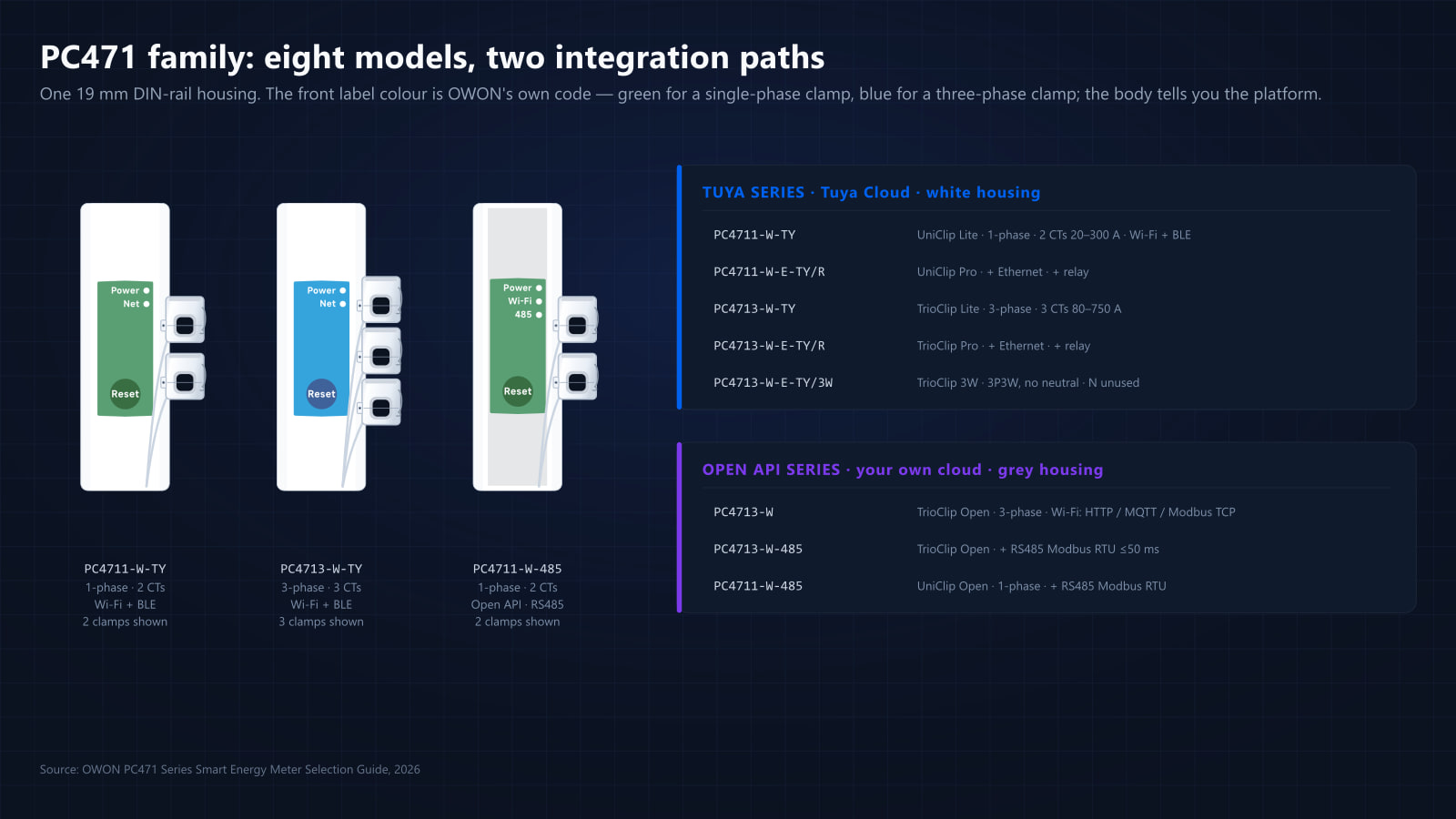
That holds across every PC471 model. What changes from site to site is the system type, the number of CTs, and whether the installation needs the relay output. If the part number is still open, the PC471 selection guide settles it in four steps; this post starts at the terminals.
The four supported systems and their terminals
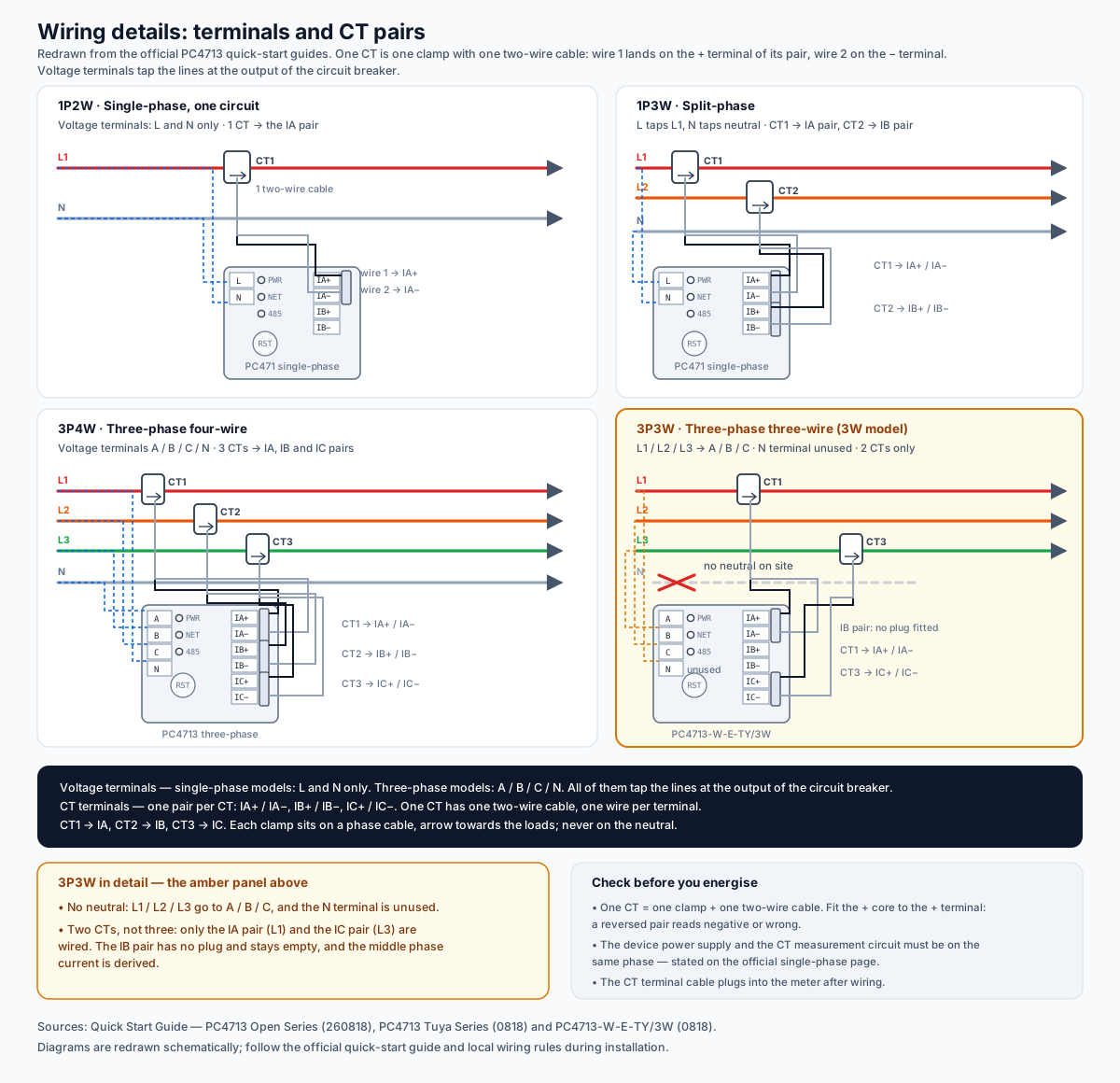
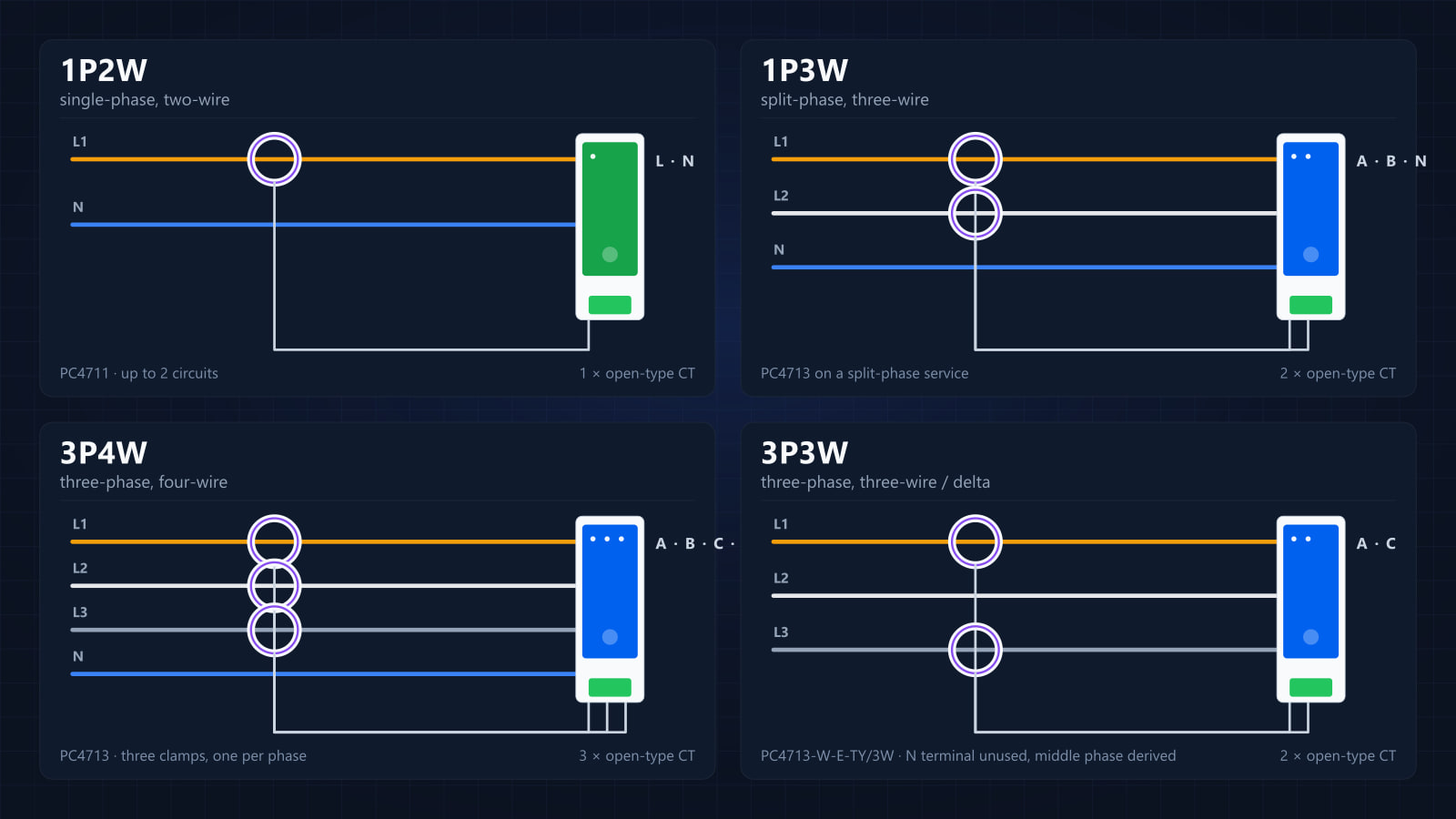
Redrawn from the official quick-start guides: how the power terminals (A / B / C / N) and the CT terminals (IA± / IB± / IC±) are wired in each system. The 3P3W panel is the one that differs — no neutral, two CTs instead of three.
Single-phase models (the PC4711 line) are built for single-phase 230 V systems. Three-phase models (PC4713) support single-phase, split-phase and three-phase four-wire — 1P2W / 1P3W / 3P4W — and the specification says so explicitly for every model in the line. The official guides specify the same CT pattern throughout:
- Voltage terminals differ by model. Single-phase meters have two:
LandN. Three-phase meters have four:A,B,C,N, connected in parallel to theL1/L2/L3/Nlines at the output of the circuit breaker. On a single-phase installation only theLandNterminals are used. - One CT = one clamp + one two-wire cable. The CT terminals are pairs —
IA+ / IA−,IB+ / IB−,IC+ / IC−— and the two wires of a single CT land on the two terminals of its pair: the+core wire on+, the other on−. CT1 goes to the IA pair, CT2 to IB, CT3 to IC. - Every CT clamps a phase cable, with the arrow pointing towards the loads — never the neutral.
- The CTs are open-type and clip on: the clamp closes around the existing cable, then the CT terminal cable plugs into the meter. No cable is cut and no supply is interrupted — that is true of every PC471 model.
- One rule worth repeating from the single-phase page: the device power supply and the CT measurement circuit must be on the same phase.
Those rules cover 1P, split-phase and 3P4W completely. The fourth panel of the diagram is the one that has to be settled before the order rather than during the installation, and it is worth its own section.
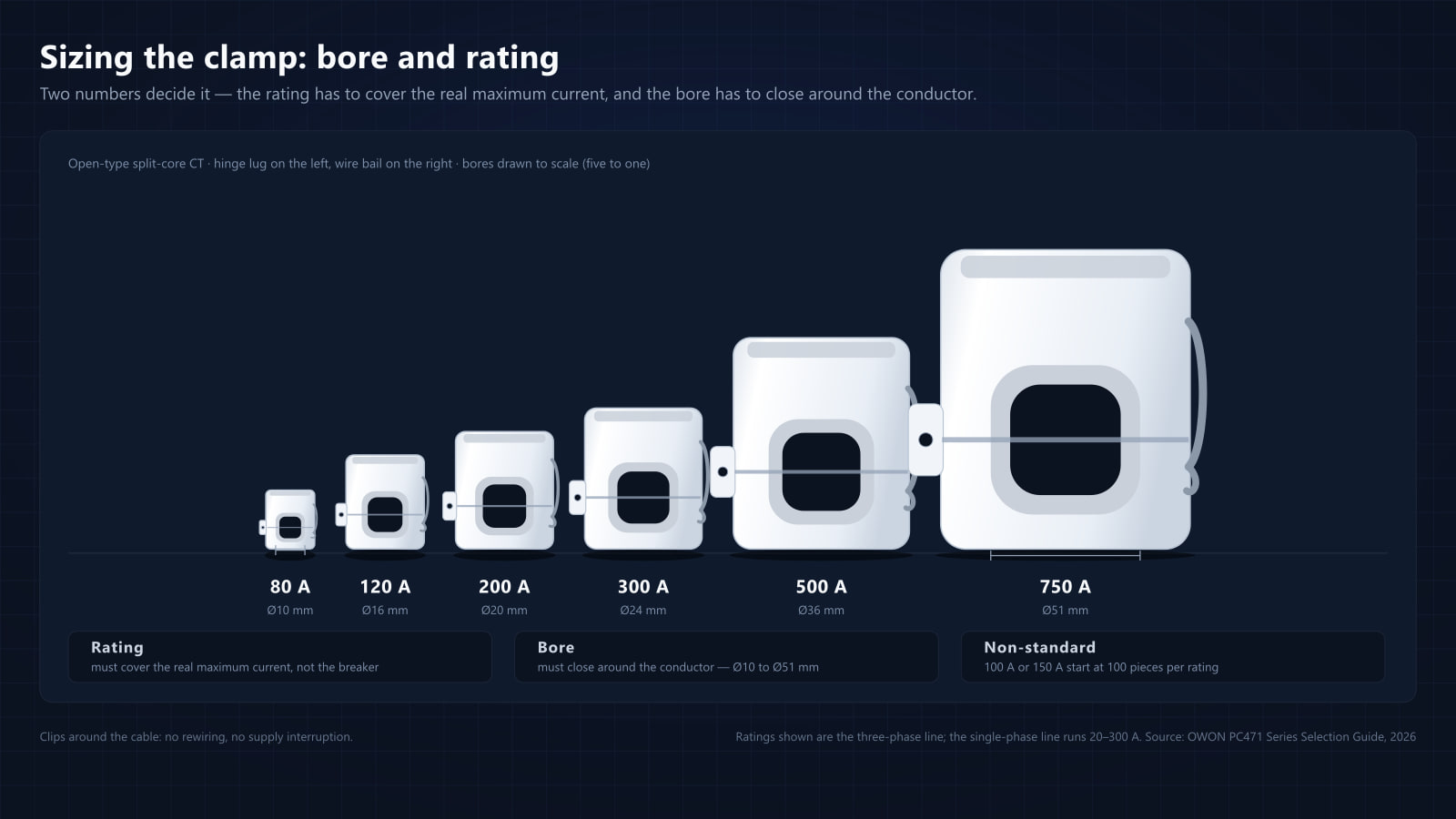
Choosing the clamp itself — rating, bore and which model line it fits — is covered in sizing a PC471 open-type CT.
Watch the exception — 3P3W
Three-phase three-wire is not a settings change; it is a different hardware configuration, and it is the single most common ordering mistake in this family.
A 3P3W system has no neutral conductor. The meter therefore has to derive its measurement reference from the phase-to-phase voltage instead of phase-to-neutral, which means a higher input voltage across the measuring circuit and additional internal adaptation — the input stage and its capacitors have to be dimensioned for that higher voltage rather than for a standard L-N tap.
The practical consequences:
- The three-phase models are built for 1P / split-phase / 3P4W. The Open API generation states this outright: 1P / Split / 3P 4W — 3P3W & Delta not supported; the
PC4711line is single-phase only. - One standard-catalogue model covers 3P3W:
PC4713-W-E-TY/3W(Tuya series). It is specified for a wider input — L-N 90–277 Vac / L-L 156–480 Vac, 50/60 Hz — and lists Single-Phase, Split-Phase, Three-Phase (included 3-Phase 3-Wire) as supported systems. - Every other PC471 model is four-wire hardware. 3P3W is a build decision made at the order, not something to enable in the app or the web config.
This also explains why the printed selection guide reads inconsistently: the family comparison table lists the Tuya three-phase models as 1P2W / 1P3W / 3P4W, while the TrioClip Pro page adds “3P3W optional”. Treat 3P3W as an order-time hardware question: state the system type up front, and only the /3W variant (or a confirmed custom build) should be quoted.
A correction worth flagging: 3P3W uses two CTs, not three, and does not use the N terminal. The 3W quick-start guide draws the three-phase three-wire diagram with the phase lines L1 / L2 / L3 connected to the A / B / C terminals — the N terminal is left unused, because there is no neutral conductor — and with CT1 on L1 and CT3 on L3 only, landing on the IA and IC pairs while the IB pair stays empty. The middle phase current is derived rather than measured. The same guide’s 3P4W page uses three CTs and wires all four terminals. So when a project is 3P3W, quote two CTs in the 80–750 A range, not three. (The family specification still lists “max 3 CTs” for this model; confirm the CT count and part numbers with OWON when ordering a 3P3W build.)
Install and commission
The mechanical work is the same for every model:
- Mount the meter on a 35 mm DIN rail. The enclosure is 19 × 69 × 90 mm — roughly a single DIN module wide.
- Clip the CTs around the conductors to be measured. Nothing is disconnected; the open-type clamp closes around the existing cable.
- Wire the voltage reference — 90–277 V per phase on standard models, so the meter tolerates wide supply variation. On a 3P3W site this is the step that differs: with no neutral, the input stage must be the
/3Wbuild rated for the higher L-L input (156–480 Vac). - Establish connectivity.
- Tuya models: BLE-assisted pairing, then full control and data in the Tuya App.
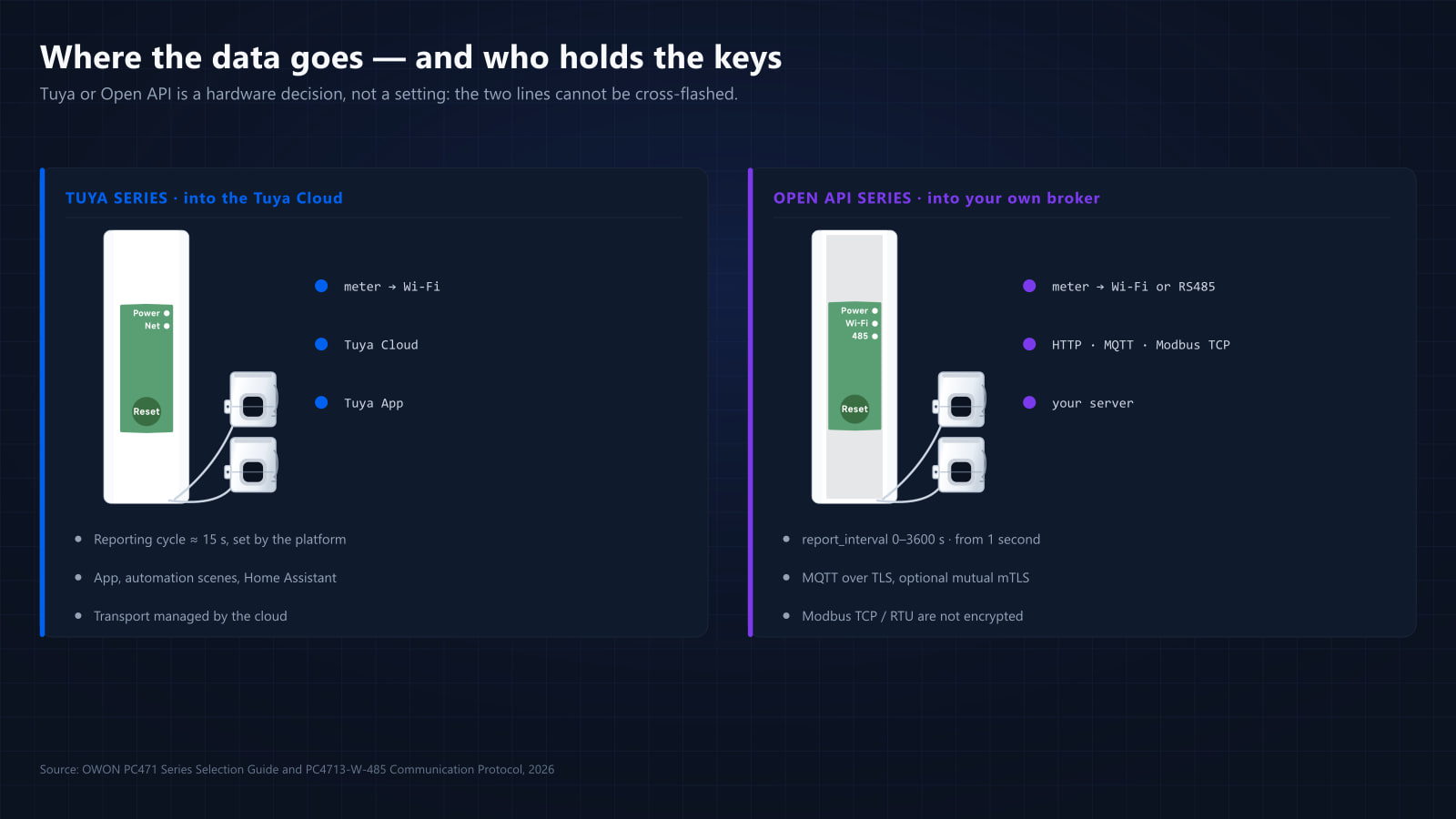
- Open API models: connect to the device’s own access point and configure it in a browser — no app required. The step-by-step walk-through, including the AP hotspot and the default password convention, is in Tuya Cloud or your own broker.
- Set the CT parameters (rating and ratio) remotely, over the app or the web config. This is also where you set the report/integration interval on the Open API models.
- Verify phase sequence — on models with the phase-sequence alarm, the meter raises an instant alarm if the phases are wired incorrectly, which turns a commissioning mistake into an immediate notification rather than a month of confusing readings.
Steps 1 to 3 are the ones a second pair of eyes should check before the panel cover goes back on: the CT arrow direction, the CT landing on the right pair of terminals, and the device supply being on the same phase as the CT measurement circuit.
Mounting, dimensions and the DIN rail
One housing is shared by every PC471 model, so the physical facts do not change between a single-phase UniClip and a three-phase TrioClip:
| All PC471 models | |
|---|---|
| Mounting | 35 mm DIN rail |
| Dimensions | 19 (W) × 69 (D) × 90 (H) mm |
| Operating environment | −20 °C ~ +55 °C · ≤ 90% RH (non-condensing) |
| Certification | CE |
The width is the number that matters on site. The PC471 is 19 mm wide — a single DIN module (19 × 69 × 90 mm, 35 mm DIN rail) — while many alternatives use wider bodies, including 2-pin-width and 6-pin-width formats. One module per meter means more circuits can be metered in the same enclosure, and retrofitting into an existing distribution board is simpler.
The operating envelope is worth checking against the panel before the meter goes in: −20 °C to +55 °C at ≤ 90% RH, non-condensing.
The relay: a dry contact, not a contactor
Among the models covered in this guide, only the two /R models carry a built-in dry-contact relay — PC4711-W-E-TY/R and PC4713-W-E-TY/R, 3 A rated / 5 A maximum, with overload protection — and relay status is reported instantly. The 3P3W build (PC4713-W-E-TY/3W) and the Open API models covered here are measurement-only; the selection guide covers when the relay is worth paying for.
The relay is a dry contact rated 3 A / 5 A — it is a control output, not a main contactor. Treat it as a signal for a contactor, a heat-pump enable input or a small auxiliary load, and use it to drive an external contactor when the load to be switched is larger than the contact itself can carry: a large load, or a whole three-phase circuit. On a three-phase line the relay is optional.
The second feature that separates otherwise identical models is the phase-sequence alarm: the three-phase models that carry it expose it as a remote setting, alongside data erase, reboot and the CT setting. At commissioning it is the difference between an immediate notification and a month of confusing readings.
Metal cabinets, weak signal and the external antenna
“The meter is going inside a metal cabinet — will the wireless drop out?”
This comes up on almost every industrial enquiry. The PC4713 mould reserves an opening for an external antenna, and antenna-equipped versions are configured per customer order — the cabinet stops being the limiting factor without changing platform or model.
Two things are worth knowing before the panel is fabricated. First, the antenna is a configured option rather than a stocked variant, so raise it with your sales contact when the batch is specified — the reserved opening is in the PC4713 mould. Second, the family already carries a wired alternative where a cable can be run: Ethernet 10/100 Mbps on the three Ethernet models (PC4711-W-E-TY/R, PC4713-W-E-TY/R, PC4713-W-E-TY/3W) and RS485 Modbus RTU on the two -485 models — so a site inside a metal enclosure, a basement or a plant room does not have to move to a different product line. The integration consequences of each path are compared in Tuya Cloud or your own broker.
The 3P3W and delta question at quote stage
“Our site is three-phase three-wire, or a delta service. Will a standard meter work?”
No — a standard PC4713 covers single-phase, split-phase and three-phase four-wire only. For 3P3W or delta, order the PC4713-W-E-TY/3W — the only standard model that covers 3P3W, delta and Y — specified for L-N 90–277 Vac and L-L 156–480 Vac and uses two CTs (middle phase derived) with the N terminal unused. This is the single most common ordering mistake in the family, and it is a hardware choice, not a setting. State the system type when ordering; it cannot be enabled later in the app or the web config.
The two CTs for that build sit in the 80–750 A three-phase range. Bore and rating are chosen the same way as on any other circuit — see sizing a PC471 open-type CT.
Ready to specify a PC471 for a project? Compare the full range on our smart meters page, or talk to our team with the system type, CT diameter, maximum current and where the data needs to land — and we will confirm the exact model and CT part numbers.
Frequently Asked Questions
Do I need to cut the power to install a PC471 meter?
No. All PC471 models use open-type (split-core) CT clamps, so you clip the CTs around the existing supply cables without interrupting the circuit. The meter itself is DIN-rail mounted, 35 mm, 19 × 69 × 90 mm.
Which systems are supported?
Single-phase models (PC4711) support single-phase 230 V systems. Three-phase models (PC4713) support single-phase, split-phase and three-phase four-wire (1P2W / 1P3W / 3P4W). Three-phase three-wire (3P3W) has no neutral, so the meter must be adapted for the higher phase-to-phase input voltage: it is supported by the dedicated PC4713-W-E-TY/3W model (L-N 90–277 Vac, L-L 156–480 Vac), and the rest of the three-phase line is four-wire hardware.
Does the PC471 series support 3-phase 3-wire (3P3W)?
Only with the right hardware. A 3P3W system has no neutral conductor, so the meter derives its reference from the phase-to-phase voltage — a higher input that requires additional internal adaptation and suitably rated capacitors. The standard catalogue model for this is PC4713-W-E-TY/3W. Treat every other PC471 model as four-wire hardware. Always state the system type when ordering; it cannot be enabled later in the app or web config.
Is the meter suitable for a metal distribution cabinet?
A metal enclosure is a site condition, not a model limitation: the PC4713 mould reserves an opening for an external antenna, and antenna-equipped versions are configured per customer order, so a cabinet does not have to become the limiting factor for the wireless link. Where a cable can be run instead, both series also have a wired path — Ethernet 10/100 Mbps on the three Ethernet models (PC4711-W-E-TY/R, PC4713-W-E-TY/R and PC4713-W-E-TY/3W), and RS485 Modbus RTU on the Open API -485 models (PC4713-W-485 and PC4711-W-485).
Does the PC471 support an external antenna?
Yes. The PC4713 mould reserves an opening for an external antenna, and antenna-equipped versions are configured per customer order rather than stocked as a catalogue variant, so raise it when the batch is specified. It does not change the platform or the model number, and the wired alternative (Ethernet on three models, RS485 Modbus RTU on the two -485 models) stays available on the same meter.
Can the meter switch a load by itself?
The two relay models carry a built-in dry-contact relay rated 3 A / 5 A maximum with overload protection, and relay status is reported instantly: PC4711-W-E-TY/R and PC4713-W-E-TY/R, the part numbers ending in /R. It is a control output, not a main contactor — use it to drive an external contactor and switch a large load or a whole three-phase circuit. The 3P3W build and the Open API models covered in this guide are measurement-only.