
· OWON Technology · Thermostats · 5 min read
Thermostat Without a C Wire: What Actually Works
No C wire at the wall is not a dead end. Here is which wires are enough, what the adapter changes, and the cases that are truly incompatible.
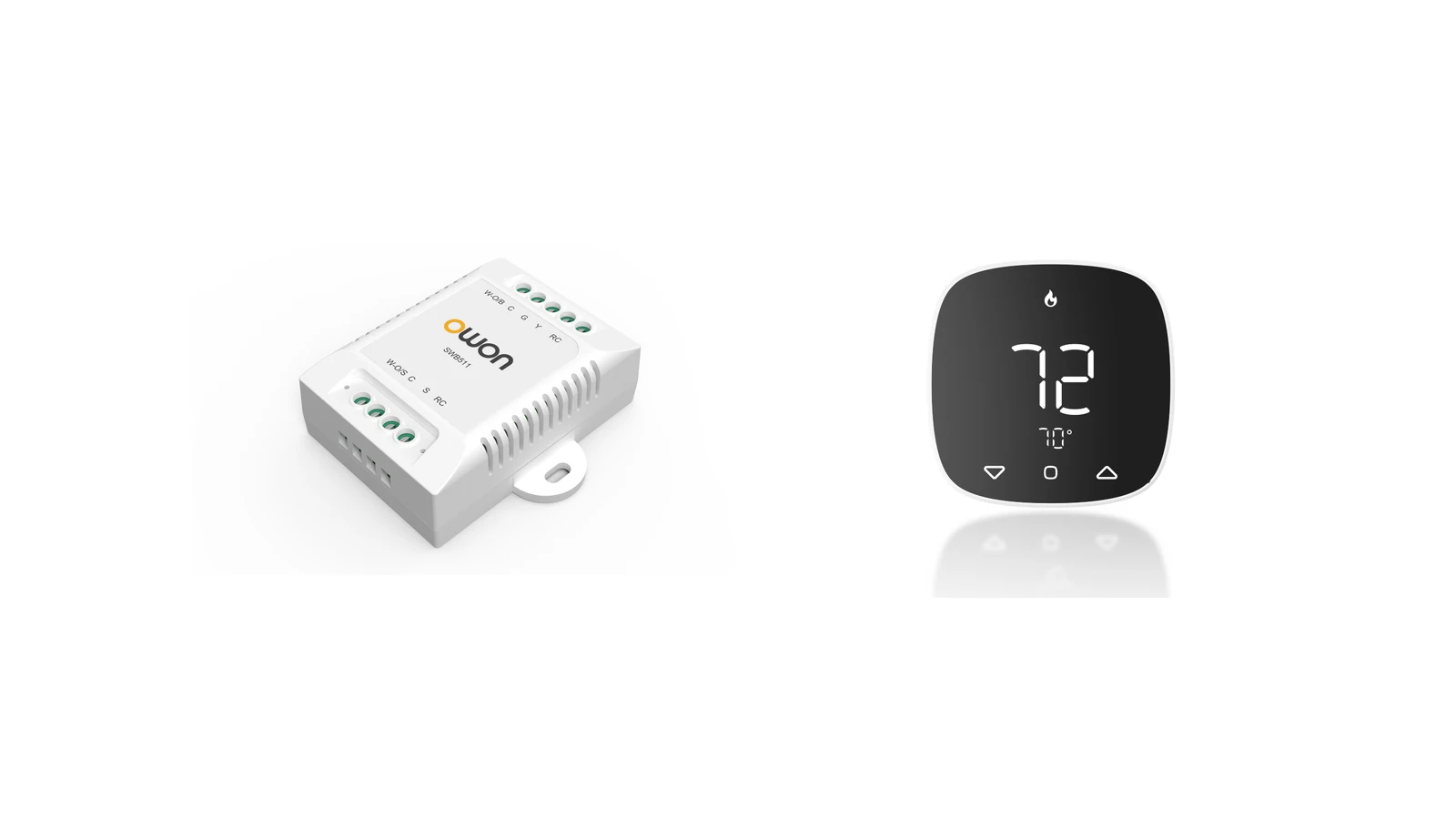
A 24VAC thermostat can be installed without a C wire as long as the wall has three wires: Y/Y1, G and R (or Rc or Rh). Those three are enough to power the thermostat through an adapter. If the wall also has W, connect it too - that fourth wire keeps your second heating stage. If there is no C wire and either Y or G is missing, the system is not compatible.
That is the short answer. The rest of this page is why it works, what changes, and how to check your own wall before you order anything.
What the C wire actually does
A thermostat is a set of switches. When it calls for heat, it connects R to W. When it calls for cooling, it connects R to Y. Between calls, all of those wires are dead - no current flows, because nothing is connected.
A Wi-Fi thermostat cannot live on that. Its radio, display and processor need power continuously, not only when the system is running. So it needs a conductor that is live all the time: the C wire, connected to the other side of the 24VAC transformer.
This is why “no C wire” sounds fatal. Without a permanently live conductor there is nothing to power the electronics. The adapter’s job is to manufacture that permanent connection out of the wires that already exist.
The three-wire test
Take the old thermostat off its base and read the letters next to the terminals.
| What you find at the wall | Can it be installed | What you get |
|---|---|---|
| C wire present | Yes, directly | Everything the thermostat can do |
| No C, but Y/Y1, G and R (or Rc or Rh) | Yes, with the SWB511 adapter | Heating and cooling, one heating stage |
| The three above plus W/W1 | Yes, with the adapter | Second heating stage or auxiliary heat retained |
| No C, and either Y/Y1 or G missing | No | Not compatible |
| Line voltage - 120V or higher, or thick wires with wire nuts | No | Not compatible, and dangerous to attempt |
The last two rows are the ones worth checking before you order, because no adapter changes them.
What the adapter changes, and what it does not
The adapter is a small module that sits between the wall wiring and the thermostat. It is powered from the same transformer, and it reconfigures the existing conductors so the thermostat gets a continuous supply.
- It does not add a wire. Nothing new is pulled through the wall.
- It does not change which system you have. A two-wire system stays a two-wire system and remains incompatible.
- It does not remove the need for Y and G. Those two wires are what it uses to build the supply, which is why they are the minimum.
- It does not cost you the second stage unless W is absent. With W present, the adapter passes it through.
Connection points differ between thermostat families: the PCT513 series uses the adapter’s Rc, W, C and S terminals, while the PCT5231, PCT533 and PCT533C series use a labelled R, Y, G, W connection with leads going to the control board. Follow the quick start guide for the model you buy.
How to check your own wall
- Switch the breaker off at the air handler or furnace before you touch anything.
- Photograph the terminal block with the labels visible. This is the single most useful thing to send us.
- Count the wires, not the terminals. Two wires can share one terminal; only the ones coming from the thermostat matter.
- Look for the jumper. If a short wire bridges Rh, Rc and R, remove it before installing a thermostat that feeds Rc and Rh separately.
If the letters are unfamiliar, or the terminals are not labelled at all, stop and send the photo. Guessing here is how people end up with a blown low-voltage fuse.
Three cases that are genuinely incompatible
These are the ones we cannot fix with an adapter, and we would rather say so up front:
- Line voltage systems. 120V or 240V, often marked L1 and L2, or with thick wires joined by wire nuts. A 24VAC thermostat cannot switch these.
- Mission wiring. If there is no C wire and either Y or G is absent, there is nothing to build the supply from.
- Systems outside the supported range - two-wire, fan coil units, multi-speed fans, ERV/HRV/VRV, baseboard heaters and 3-stage conventional heating. The full list is on the 24VAC thermostat page.
Is the adapter the same part every time?
Yes. It is the same part whether it arrives inside a thermostat box or on its own: samples and small orders normally include it, and bulk orders can purchase it under the same part number, SWB511. Nothing about the hardware changes between the two cases - only the line item.
Check before you buy
If you are not sure which case you are in, the compatibility check walks through the wiring in four questions and returns the models that fit. If you would rather have a person look at it, send a photo of the terminal block to our engineers - we will tell you which model works and whether the adapter is needed.
For the differences between the thermostats themselves, see the full comparison. Wiring diagrams for each model are in the documentation library.
Frequently Asked Questions
Can a 24VAC thermostat run without a C wire?
Yes, if the wall has Y/Y1, G and R (or Rc or Rh). Those three wires are enough for the SWB511 C-Wire Adapter to power the thermostat. If you also have W, connect it too, because it keeps the second heating stage.
What does the C wire actually do?
It is the return path for the 24VAC control transformer. Heating and cooling wires only carry current when the system is running; a Wi-Fi thermostat needs power all the time, so it needs a conductor that is live continuously.
Will a three-wire install lose functions?
It loses the second heating stage, because the second stage is switched by W. Heating and cooling, the fan and scheduling all still work. If your system is a heat pump, the changeover valve also needs a conductor, so check the terminal list for your model.
What makes a system genuinely incompatible?
Three cases. No C wire and either Y/Y1 or G missing; line voltage at 120V or higher; and thick wires joined with wire nuts instead of connected at terminals.
Is the adapter included with the thermostat?
It is the same part whether it ships inside the thermostat box or separately. Samples and small orders normally include it; bulk orders can purchase it under the same part number, SWB511.
How do I know which wires I have before ordering?
Take the old thermostat off its base and photograph the terminal block. The letters next to the terminals follow the same convention across North American equipment, so the photo is usually enough for us to confirm the model and the adapter.